Introduction to Business Analytics
Previous Lesson:
Next Lesson:
Learning Objectives
By the end of this lesson, students will be able to:
(1) Define analytics and explain its importance in business decision-making.
(2) Differentiate among descriptive, diagnostic, predictive, and prescriptive analytics.
(3) Identify the appropriate type of analytics for different business situations.
(4) Explain how business analytics is applied in major business functions such as marketing, finance, HR, and operations.
Analytics
Analytics is the systematic use of Data, Statistical/Mathematical Methods, and Computational Tools & Technology to discover meaningful patterns, generate insights, and support decision-making.
In simple words:

Definitions of Analytics
“Analytics is the systematic computational analysis of data or statistics. It is used for the discovery, interpretation, and communication of meaningful patterns in data.” (IT Research & Advisory Firm)
“Analytics is the extensive use of data, statistical and quantitative analysis, explanatory and predictive models, and fact-based management to drive decisions and actions.” (Harvard Business School)
“Data analytics is the process of examining data sets to draw conclusions about the information they contain, increasingly with the aid of specialized systems and software.” (IBM)
“Analytics is the systematic computational analysis of data or statistics.” (Oxford Dictionary)
“Data analytics is the science of analyzing raw data to make conclusions about that information. It involves applying algorithms and mechanical processes to derive insights, identify patterns, and support decision-making.” (Investopedia)
“Analytics is the use of data, statistical analysis, and modeling to gain insights and drive better decision making.” (Consulting Firm)
Self-Assessment
(Tab to RIGHT OPTION to see the answer)
Types of Analytics
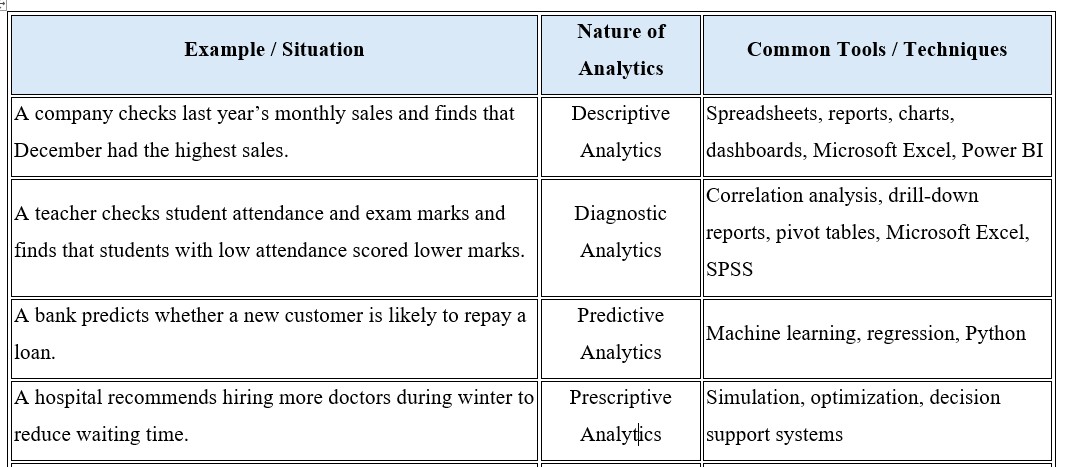
Descriptive Analytics – What happened? (Reports, Dashboards, Summaries)
Diagnostic Analytics – Why Did It Happen? (Root Cause, Correlations)
Predictive Analytics – What is likely to happen? (Forecasts, Models)
Prescriptive Analytics – What Should We Do? (Optimization, Recommendations)
| Type of Analytics | Question It Answers | Example in Business |
| Descriptive | What happened? | Monthly sales reports of KFC |
| Diagnostic | Why did it happen? | Why did Pizza Hut’s sales drop in August? |
| Predictive | What will happen? | Predict next year’s iPhone sales |
| Prescriptive | What should we do? | Should Daraz give discounts or free delivery to boost sales? |
Descriptive Analytics
Descriptive analytics is the most basic type of analytics. It looks at old data and summarises it in a simple form such as reports, tables, charts, and dashboards. It helps an organisation understand what has already happened. It answers questions such as the following:
- How many products were sold?
- How many students attended class?
- Which month had the highest sales?
- Which subject had the lowest marks?
For example, a company may study its sales for the last year and find the following:
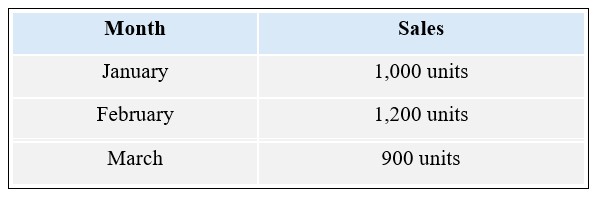
From this table, the company learns that February had the highest sales and March had the lowest sales. This information only describes the situation. It does not explain sales increases or decreases. Therefore, this is descriptive analytics. Common tools used in descriptive analytics include:
- Charts and graphs
- Dashboards
- Reports
- Percentages and averages
A shop owner finds that 60% of customers buy products in the evening. This helps the owner decide when more staff are needed.
Diagnostic Analytics
Diagnostic analytics goes one step further. After seeing what happened, it tries to find the reason.
It answers questions such as the following:
- Why did sales fall?
- Why did profits increase?
- Why did students perform badly?
- Why are some customers leaving?
Suppose a company notices that sales dropped from 1,200 units in February to 900 units in March. Descriptive analytics only show the drop. Diagnostic analytics investigates the reason.
After examining the data, the company may discover:
- Prices were increased
- A competitor launched a cheaper product
- Advertising was reduced
- The product was out of stock for several days
Now the company understands why sales have decreased.
Predictive Analytics
Predictive analytics use past data to make a forecast about the future. It does not give a guaranteed answer, but it tells what is likely to happen. It answers questions such as:
- What sales may be next month?
- Which customers may stop buying?
- Which students may fail?
- What products will become popular?
For example, if a store sees that ice cream sales increase every summer, it can predict that sales will rise again next summer. Suppose a company has the following data:
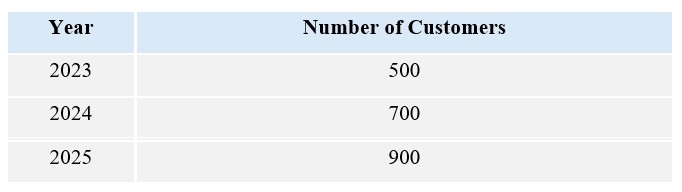
Using this pattern, the company may predict that there will be around 1,100 customers in 2026. Predictive analytics is widely used in banks. A bank studies a customer:
- Income
- Loan history
- Past repayments
Then it predicts whether the customer is likely to repay the loan. Another example is in education. A university may study:
- Attendance
- Quiz marks
- Assignment marks
Prescriptive Analytics
Prescriptive analytics is the most advanced type of analytics. After predicting what may happen, it suggests the best action to take. It answers questions such as:
- What should the company do to increase sales?
- What should the teacher do to help weak students?
- Which product should be recommended to a customer?
- How can the best result be achieved?
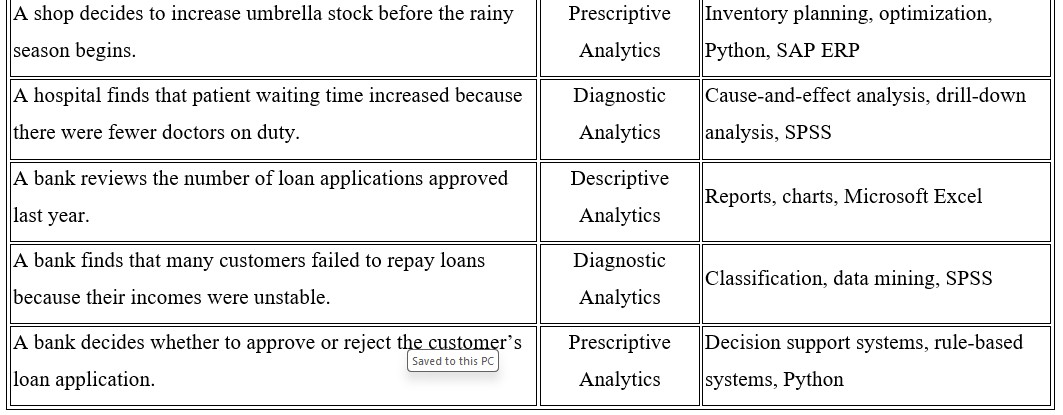
Suppose predictive analytics shows that sales may fall next month. Prescriptive analytics may recommend:
- Give a 10% discount
- Spend more money on advertising
- Offer free delivery
- Introduce a new product
Self-Assessment
(Tab to RIGHT OPTION to see the answer)
Descriptive analytics mainly answers the question?
Which type of analytics is used when managers want to know the reason for declining sales?
Which of the following is NOT a type of analytics?
The key benefit of analytics for organizations is?
Which of the following is a modern application of analytics?
A dashboard that summarizes monthly sales figures is an example of?
Forecasting next quarter’s sales using past data is an example of?
Data visualization tool Power BI are mainly used in?
Which of the following best represents the sequence of analytics maturity?
Which of the following industries uses analytics for fraud detection?
Prescriptive analytics provides?
Predictive analytics is primarily used for?
Diagnostic analytics is mainly used to answer?
Share your Results:
Business Analytics
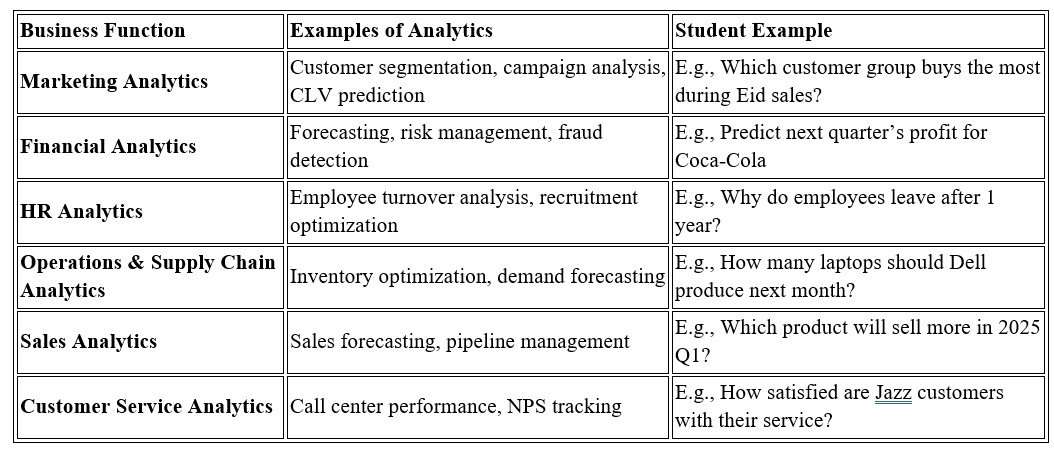
Business Analytics (BA) is the practice of using data, statistical methods, and predictive models to analyze business performance, identify trends, and support decision-making. It transforms raw data into actionable insights that guide strategies in areas like marketing, finance, human resources, and operations.
Self-Assessment
(Tab to RIGHT OPTION to see the answer)
Demand forecasting and inventory optimization are part of?
Customer segmentation and campaign analysis are part of?
Fraud detection is a common application in?
If a company asks, “Should we open a new branch in Islamabad?” it needs?
Budgeting and forecasting are key tasks of?
Pipeline management is an example of?
Employee turnover analysis belongs to?
Share your Results:
Related Topics
Accounting Definition
More Interest
Types of Businesses MCQs
Further Readings
Principles of Accounting
References
0 Comments